
Five years since uprooting himself from O‘ahu, the outspoken Hawaiian editor of Monster Children, unpacks NYC’s influence on his POV.
Images by Brandyn Liu
The first time I saw Naz Kawakami was in the indie film Every Day in Kaimukī where he stars as its main character also named Naz Kawakami. The second time was in person, sitting across from each other on a mid-November morning in the Kaimukī café beneath what used to be his and his character’s former apartment. The 30-year-old writer and editor had bedhead and scruff and wore a tattered black T-shirt and black corduroy shirt with a lapel button that said “kiss me.” He was back in Honolulu from his base in Brooklyn for just a few days, staging an art show in Chinatown on local skate culture. Like the caustic version of himself he portrays in Every Day in Kaimukī, an autofictive narrative that blurs autobiography with fiction, Kawakami also left O‘ahu for New York in 2021 to escape what he sees as the crushing confines of island life. Within two years, the real Kawakami (who has a greater deal of work ethic than his on-screen persona) worked his way from freelance journalist reporting for NPR, Insider, Creem, and Vice to the editor-in-chief of Monster Children, where he shepherds the good word on skating, bands, and parties.
The writer-director Alika Tengan of Every Day in Kaimukī told me how he came up with the story: He found his “most interesting friend,” asked him for his life story with a tape recorder running, wrote a script with him, and shot the film with cinematographer Chapin Hall. The friend, of course, was Naz Kawakami, Honolulu born and raised. The film, about a young prickish late-night radio DJ who’s trying to muster leaving Kaimukī for New York, ran at Sundance in 2022 and was nominated for the Innovator Award.
To spoil the story, both Naz’s get off the rock. But, the real life Naz still kept his opinions about art made in Hawai‘i, gripes that, as he’d put it, are in the interest of wanting to see better art. As he writes of himself online, “I am Hawaiian and Japanese but I look like neither of those things and my confused sense of identity bothers me very much.” He is not confused, however, about his wishes for Hawaiian films. “So few opportunities are given to Hawaiians to make films that they feel they have to say everything [about the] Hawaiian [experience],” he told me. “Every film comes out feeling like a lecture.”
This interview, edited and condensed for clarity from two conversations, ranges from his local film critiques to how to throw a party.
Jack Truesdale What do you think of the films that have come out of Hawai‘i, and how’s that changing?
Naz Kawakami I strongly believe the reason that Hawaiian film has not been very good in the past, including, like, Disney shit — the reason it’s been very corny is because so few opportunities are given to actual Hawaiians to make films that when they do, they’re like, “Oh, I need to say everything I’ve ever experienced,” instead of saying one thing really well. So every film comes out feeling like a lecture. Like, say your one thing, and then make the next one and say something else. Don’t try to jam hundreds of years of historical trauma down someone’s throat who just walked into Hawai‘i International Film Festival for a short showcase or a quirky beach surf film. Like, how often in day-to-day conversation, are you like “1893”?
Some of these films I see, I’m like you may as well just talk to camera, you may as well just address us directly with a chalkboard. Someone that I think did it really well was — not for Hawai‘i, but for Maori history — Taika Waititi. His first short, Two Cars, One Night, he shows the squalor that they live in, and no character is like, “Oh, man, shucks, being Maori is really hard, isn’t it?” The viewer can make that connection. The viewer on their own might be stupid, but as a whole, we’re quite smart. So even though one person may give you a note that’s, like, “Why don’t you talk about the annexation?” Like, don’t. Because if you just show the aftermath, the effects of it, they’ll gather.


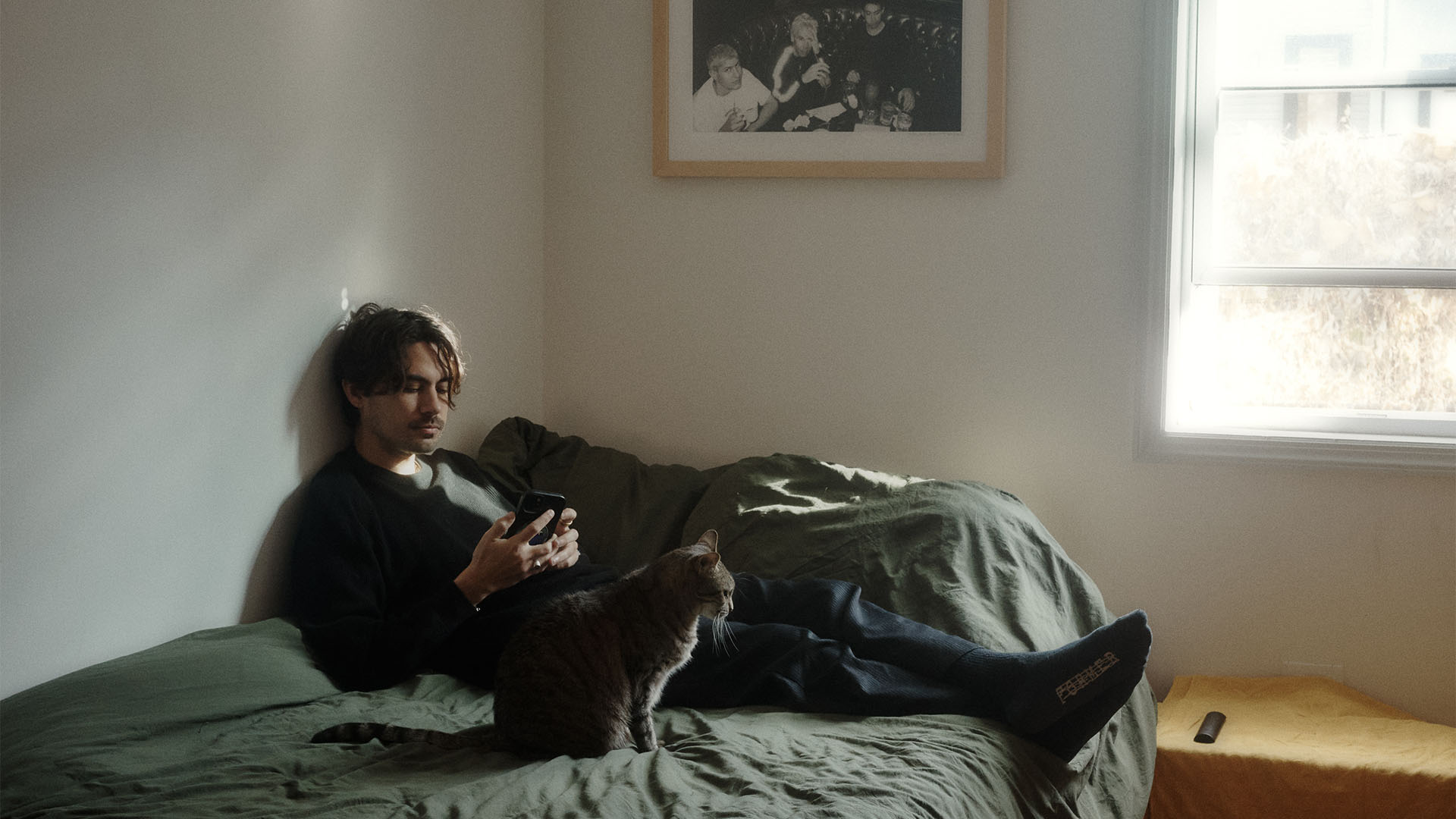
Kawakami moved from Honolulu to New York in 2020, a transition that became the basis for Alika Tengan’s Every Day in Kaimukī. Today, he lives in Brooklyn with his cat, Meow Meow Beans.
JT You think a development executive would say that?
NK Yes. People have said that to me. They’re like, “No, I want people to know the history.” And I’m like, “They’ll Google it later.” And also, it doesn’t matter with dates. All that matters is the effects. The event itself is almost insignificant compared to everything after it. If your script has any of the characters explaining to another the events of 1893 in it, it’s a fucking lecture. Show how your characters are affected by it, and people will feel it. They’ll feel that something went wrong [in Hawaiian history]. They’ll feel that something is not right. Like everybody on that Maori reservation in [Waititi’s second feature] Boy was fucking poor, and you immediately ask yourself, why? And that’s all you need to do.
JT Do you feel free to say whatever you want because you’re not here [in Hawai‘i]?
NK Yes, in the past. I was very vocal about my opinions, good and bad, about Hawai‘i filmmaking. Until someone at HIFF pointed out to me that I had made nothing and had no right to be an asshole about it. So, when Alika asked if I wanted to make a movie with him, I was like, “Yeah, OK, let’s do it.” Let’s put my money where my mouth is.
These days, I just believe that Native Hawaiian filmmakers are capable of more, and that Native Hawaiian history and community deserves authenticity and subtlety more than ever. We are capable of and more deserving than to just make films about being downtrodden and of our worst moments. We just keep making films about being figuratively “overthrown” and being criminals. And from what I can detect these films are about that and little else. I get really frustrated by that because there’s good and bad. We’re a complex people with a rich history and culture. We don’t need to focus all of our efforts on convincing people that we’re hurt, convincing viewers — and ourselves too. I think you can represent trauma with nuance. It fails us as a people to only dwell on those things. We need laughter with the tragedy. We’re good at that, so why is that not reflected in our stories?
So few opportunities are given to Hawaiians to make films that they feel they have to say everything [about the] Hawaiian [experience]. Every film comes out feeling like a lecture.
Naz Kawakami
Toni Morrison’s Beloved is, I think, a masterpiece. It’s one of my favorite books of all time, and it’s about slavery, but none of them are slaves. It’s after the fact, and none of them in the book are like, “Oh, boy, remember back when we were slaves?” No one wants a spoon in their face. They don’t want to be told a story without having to feel it, and you’re not going to feel names and dates and talking points. In Beloved, you feel the struggle of these people, you know their circumstances and, on your own, you come to the conclusion of why. That’s better storytelling. If you’re writing a story in Hawai‘i about Hawai‘i, and on the cast sheet, it’s the Queen, you’ve gone wrong. You’ve gone astray. Unless it’s like pre-Overthrow, great. But I don’t think it’ll do anyone any service to have reenactments.
JT It’s the pull between feeling you want to represent your people or home, and do it justice, while making something a wide range of people want to see.
NK The word you just used is “representation,” not “reenactment.” You want representation, not a crying reenactment of the worst thing that happened in Hawaiian history. If Beloved took place while they were slaves, that would be a horrible novel. I’ve argued about this in college classes. I’ve been on this shit for years.
JT Do you feel like anything does it right? Any movies or books you’ve encountered?
NK I don’t know if I’ve seen enough Hawai‘i stuff. I didn’t see the feature version yet, but Alika’s short Moloka‘i Bound, I thought was really good — it’s a vignette of a tragedy. They don’t ever talk about why the dad’s not supposed to be there. They don’t talk about why they’re in their circumstances. Because why would they? Who discusses that? The viewer can pick up on all of their history by them having this struggling conversation and their tone, their body language. It’s a minimalist representation, and because I, as a viewer, have to extract that information myself, it’s more impactful. I feel it. I remember it. I remember it now. I saw it years ago.
JT What is the story you’re working on?
NK It’s a film. I cannot think of a single fun Hawai‘i film. They’re all kind of downers. So my Hawai‘i film, it’s just, uh… fun. It’s like 80 percent fun, 10 to 20 percent bummer. There was a huge punk rock scene here when I was growing up [in the late-aughts]. So it’s about a 14-year-old kid who’s just in that scene. It takes place on Halloween night, one night only. And it’s just him trying to talk to girls, not get beaten up by bullies, and it ends up being very sad. It starts with his older brother getting back from having tried to kill himself. One of the lines in it that I think is so hilarious is someone being like, “Hey, sorry you tried to kill yourself.” And he’s like, “It’s okay.” It’s treated very mildly. Everyone that this older brother interacts with already knows what happened. It’s not taken very seriously because that’s usually how it is. And I didn’t want to just beat people over the head with, like, “Look how poor and sad these people are.” I want to have a little aspect of it, but not have the character be pitied. Everyone’s just like a normal guy. Sure, they’re goths, they’re sweating and walking around wearing all black in Hawai‘i, but they’re just normal people. A very unchallenging, fun movie.

JT The story all takes place in town?
NK All over. I wanted to recreate all these clubs that I used to go to. Coffee Talk is in it. I played my first show there when I was 14 at like three in the afternoon. I had a mohawk.
JT Do you feel like that side of you was nurtured much here growing up?
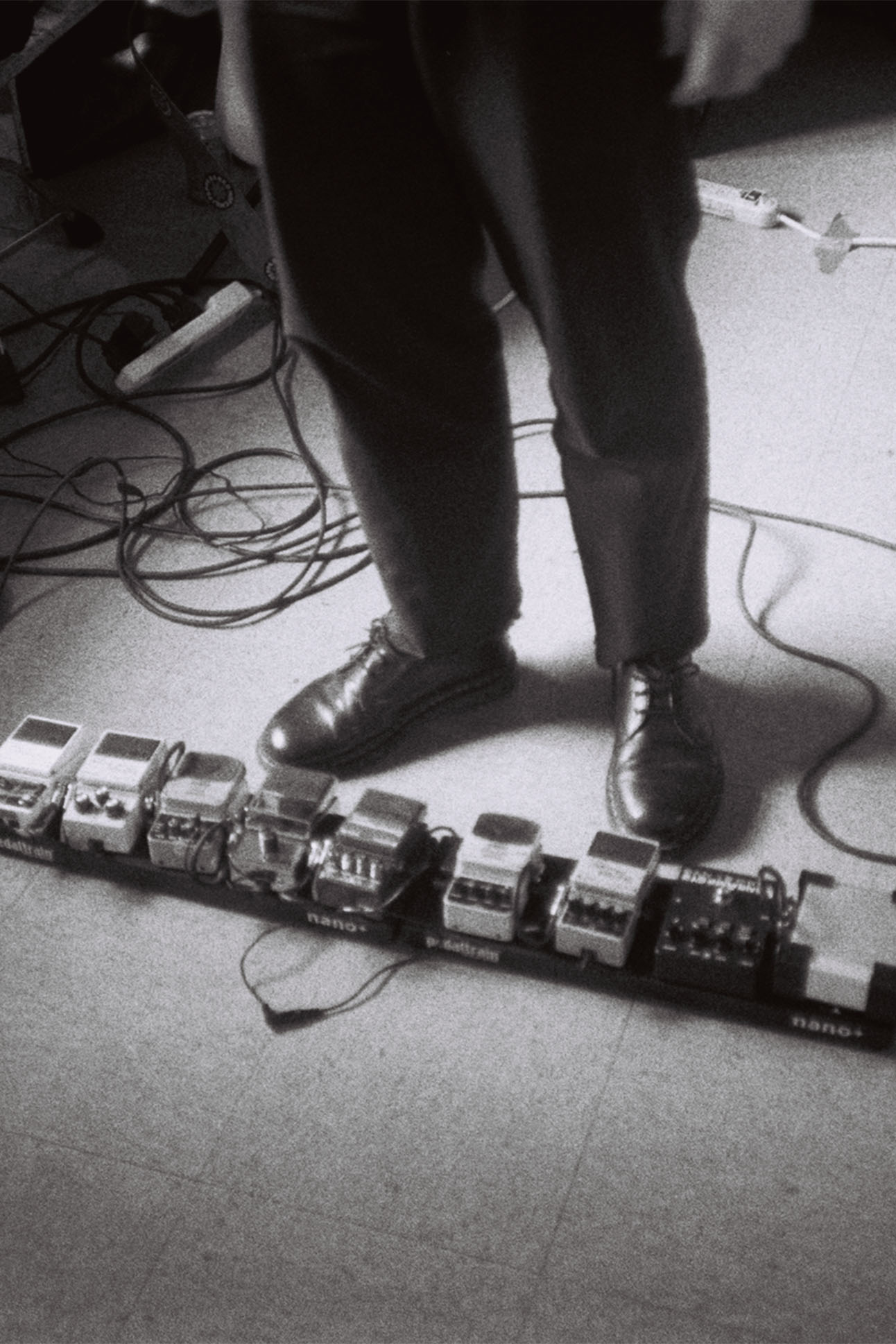
NK Yeah. There was a heavy scene. Hundreds of people. Dozens of bands. If you were goth, you had a place to go. If you were a punk, you had a place to go. I tried to be punk, but I wasn’t very good at it. There was just so much happening. If you were an artist, there were places to go and meet other artists. Now it’s not so much like that. If, for some reason, someone in their twenties reads this interview, please put this in, even unprompted at the end: stop waiting for an invite, throw the party. You don’t need much. You literally just need a space and a sound system. People will bring their own fucking beer. If you tell people to go to this warehouse and you have a loud ass speaker and a fucking Spotify mix, you don’t need anything. Turn off the lights, you’re good.
JT I remember reading your Monster Children piece on how to throw an illegal warehouse party.
NK That gets thousands of clicks per month. So many people are interested. Just fucking do it.
JT Where would you do it in Honolulu?
NK Aupuni Space a lot. We did a whole bunch in Chinatown, just anywhere. If we saw a For Lease sign, we’d call and be like, “Can we lease it for a day for an art show?” Because they’re thinking wine and cheese, some paint on the walls, and they’d never come and attend. So we would scrounge together like 300 bucks, throw a sound system in there, one disco ball, and one spotlight — you’re good. That’s all you need. You don’t need much to have a good time.
I’ve discovered that if you want to loosen up a party really quickly and make people weird, change how they think about their self image. The thing that unlocks people and parties? Fucking costumes, man. Throw a costume party or just have that shit lying around. I threw a party in New York in an expansive room. I just had a wig on the table or a mask over there. I’m not saying put it on, but put a beer in someone, turn the lights kind of low, and put on some music, everyone’s in costume. And it makes them do weird shit. It makes them get rid of their ego because they’re automatically something strange. It gets people talking more easily because there’s no ego barrier. It just breaks people wide open. My kind of stuff isn’t for anyone who was cool in high school or has a “K” on their Instagram page.

JT A what?
NK Like a 10K or 40K. You know, followers. Everything I do is for the weird kids. I thought I was pretty weird. And I went on this trip to Japan with these pros [skaters and surfers], and they were way weirder than me. I watched them and was like, that’s how you should be. Do you know what a pratfall is?
JT Yeah.
NK Just falling on purpose for a gag. They did that shit in Japan. They would be in the bar. And these are people you think of as really cool guys. They’ll be in the bar, and they’ll be like, I’ll be right back, and they’ll be holding a full beer, and they’ll fall on a full table of people and tear the whole table down for a gag, and then pretend to slip and fall back down. I’m like, “Holy shit, you guys are amazing.” So I’ve been really into that lately. Me and my friends have been really into pratfalls. We walked into this bar, this fancy French restaurant where it’s $20 a beer. We walked in and just immediately fell and ripped down a table down of hors d’oeuvres and cheeses. The diners were like, “Are you okay?” And then I slip again, and I fall down. It’s just so fucking funny.
Seeing these people who are dressed to the nines, like influencers, be so disgusted with me is so funny. All right, we’re getting way off…
JT What have you learned living in New York you might not have learned if you didn’t move?
NK An infinite amount of lessons. Everything from how to tell if someone is about to rob you to what natural wine is. From day one — really, from hour one — I was just getting my ass kicked by the city. It took a lot of time and trial and error to be comfortable with myself and the distance from everyone I know and my own choices for coming to New York.
JT But what about yourself, in so far as your relationship to Hawai‘i?
NK I know that I spent my whole life thinking that being a Hawaiian man, ethnically and having that as a cultural background, was the fucking lamest thing on the planet, and I resented it and didn’t engage with it when I was at home. Only since moving have I begun to feel pride in it and start to feel — not so much my otherness when I’m here, but my sense of self is much stronger here because in Hawai‘i it’s just how things are. In New York, I need to be really direct and practical and literal in my engagement with Hawaiian culture, heritage, history. It’s not around me anymore, so I need to set aside time for it and learn it and commit myself to it which has been really rewarding actually.

JT Have you come to understand the reason why you resented it, as you say? What do you think is the deeper explanation for that feeling?
NK Yeah, I don’t know, my dad grew up in a time where speaking Pidgin and being Hawaiian meant that you were, like, stupid, and I remember my parents — I feel kind of bad calling them out on this actually — it’s not a call out though, it’s fine. One time they were like, “Don’t speak Pidgin.” I remember being really young and I made a joke and saying it in Pidgin, and they were like, “Don’t speak that way. Speak proper English.” It was like an academic and societal thing.They didn’t say this, but the sentiment was, “Don’t be that, be something else, be smart.” My dad was also in Hawaiian bands and he would take me to these live music places and every time I would go I’d be thinking to myself this is fucking not very punk rock, this sucks. (Laughs) I didn’t see the value in it because I just had this idea of what is valuable and what isn’t. Which is such a — and I hate to use this term — colonial way of thinking that anything Hawaiian was sort of negligible and stupid than whatever is being imported from America or the West.
JT You’ve been editing Monster Children for a couple of years now. How’s that going?
NK Well, print is always doing good and it’s only going to get better.
JT A highly sarcastic and meta comment to make in this print magazine interview!
NK I’ll say I’m grateful to work at a place that’s down to be weird and have strong opinions about everything. I feel to survive in the media landscape people have started to loosen their opinions, especially in skating and music, which I work in. I think that’s why Monster Children has been around so long and readers respond to it because of the magazine’s independent voice. What I’ve observed is how Monster Children supports and highlights the people who are doing weird, cool shit, you know? If it’s a choice between covering someone who’s uncontroversially adored and someone doing something radical, we’ll usually go for the radical person because they’re innovative and we applaud the attempt. Even if it sounds quixotian, we’re a platform for the people who we feel will be cool tomorrow, even if they’re eating shit for right now. a